

Updated
«Las cuerdas de mi charango traducen mis sentimientos: cuando estoy contento ríen, cuando estoy con pena lloran.»
José Prudencio Bustillo, 1922
“The strings of my charango translate my feelings: when I am happy they laugh, when I am sad they weep.”
The charango is a stringed musical instrument of the lute family, of Andean origin but now widespread throughout much of South America. Its sound is ringing, penetrating but extremely sweet.
It is the most widespread native instrument of the Andean region, particularly on the Altiplano and in the valleys of Bolivia, where its origins most likely lie. However, it is also found in Peru, Ecuador, Chile and Argentina, again around the Andean plateau, where it has slowly spread over the years. It is also one of the most important instruments in Latin America, and although its recent spread has also taken it far away from its geographical origins, the charango still plays an important role within the indigenous traditions of the Quechua people, the most widespread ethnic group in the Andean highland area. If you want to understand what the charango is, read on: there is much to discover.

What the charango looks like
The charango is quite small in size, with an overall length that hardly exceeds 65 cm (25.6 in), and a scale length (the vibrating length of the strings) of about 38 cm (15 in). Its size, and its tuning too, often lead people to mistake it for a ukulele, with which it does to some extent share part of its history.
It is an instrument with a large number of variations. There are so many that it would be more accurate to say that the charango is a true family of chordophones. The variants differ greatly in size, shape, tuning and materials. However, there is one version with a specific shape and tuning that has become established and widespread throughout the world, which is called the standard charango.
The charango has a few special features that distinguish it from other stringed instruments: it is often carved from a single piece of wood, which is hollowed out into a concave, shell-like soundbox with an upper contour roughly resembling that of a guitar. This is one of the main characteristics of the Bolivian charango, of which the makers are particularly proud. The reason for this specific shape is unclear but can be traced to the evolutionary history of an instrument that until a few decades ago was also made from the shell of an armadillo or from other animal parts, such as the breastbone of a condor or the carapace of some gastropods. Today, however, wood is used almost exclusively.
The most common woods used to construct the charango’s body are two: jacaranda, a rosewood (Dalbergia), with a reddish-brown color and characteristic knotty grain, and naranjillo, with a straw-yellow color and orange veins, by far the most widely used wood, so much so that it is known as the charango tree. Jacaranda is harder and more stable against changes in humidity, which is why it is considered the finer wood and is used on concert charangos. However, there are many other woods that can be used: tarco, quina quina, and sotomara are just some of them.

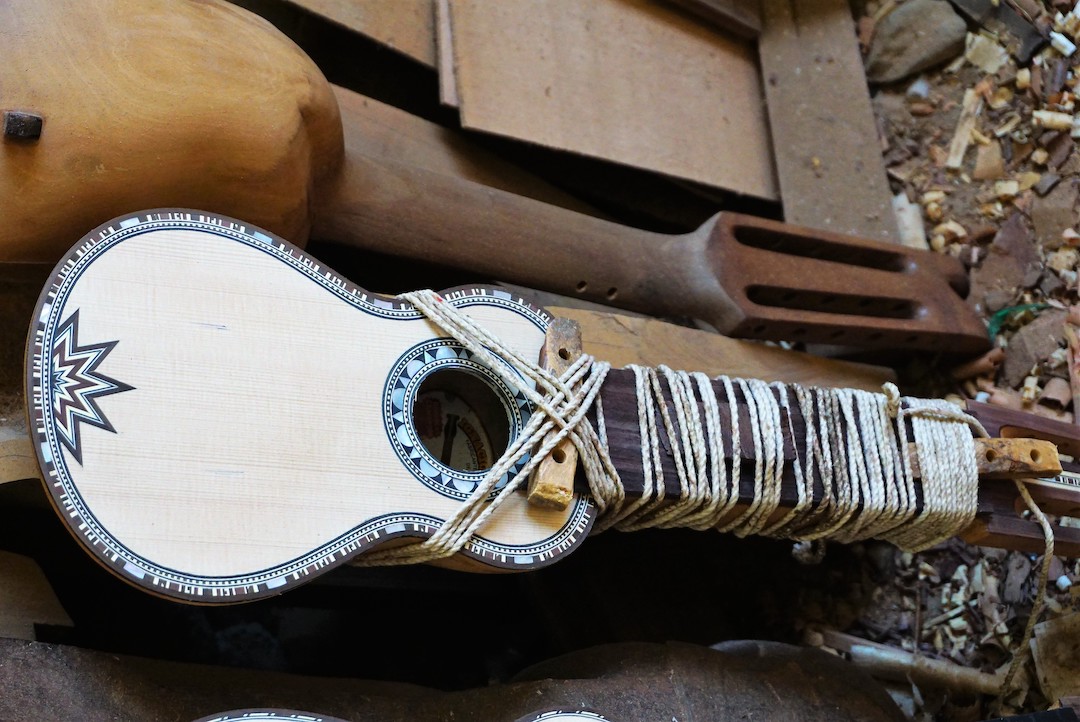
Gluing the fretboard of a charango 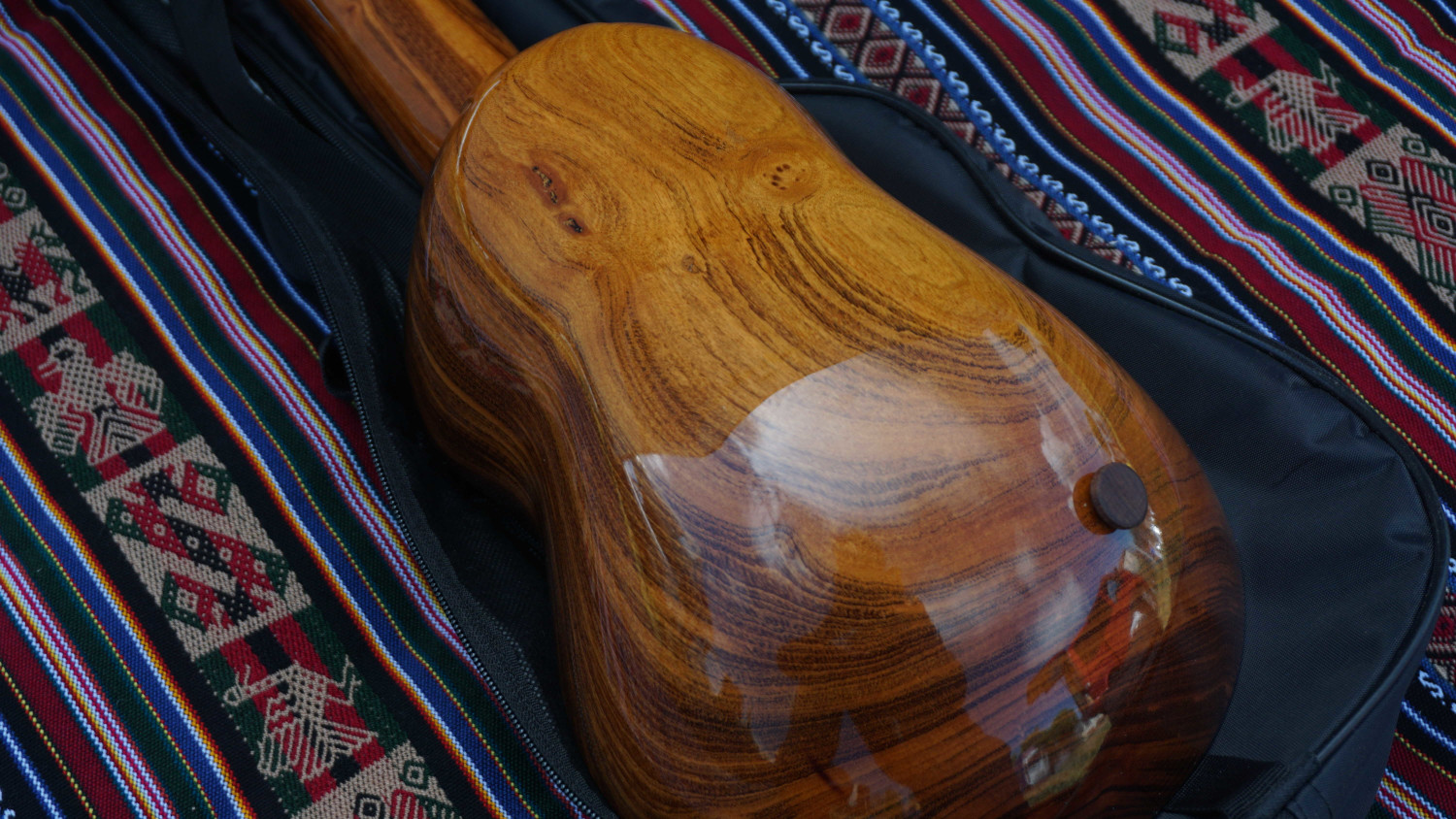
The back of a jacaranda charango 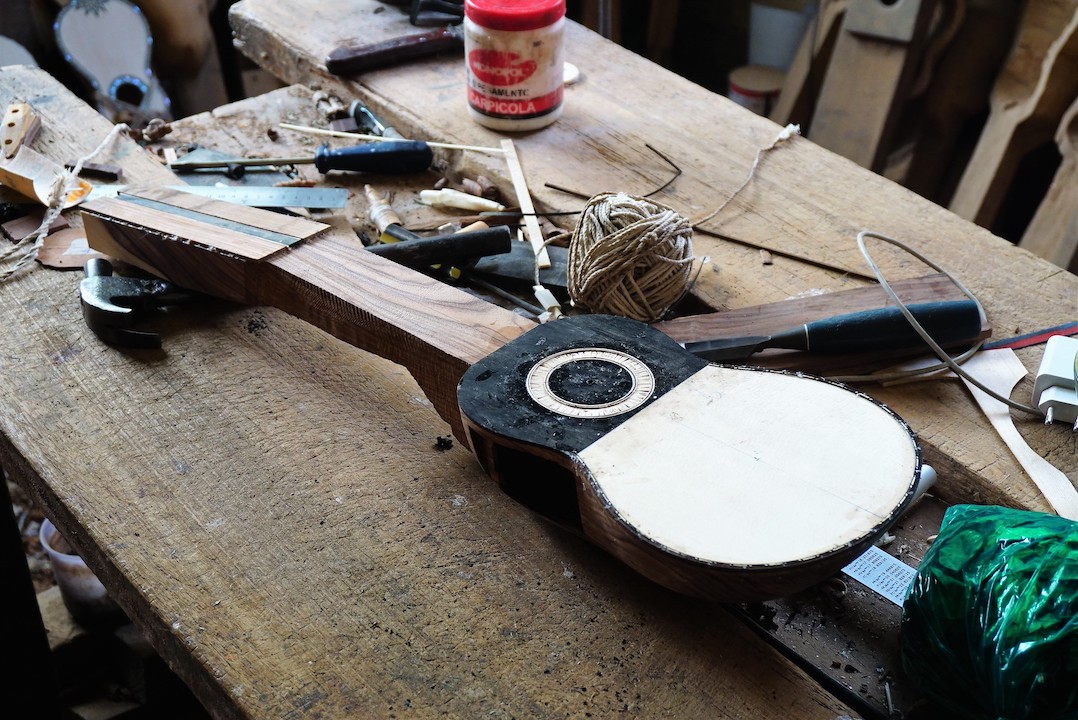
A charango under construction 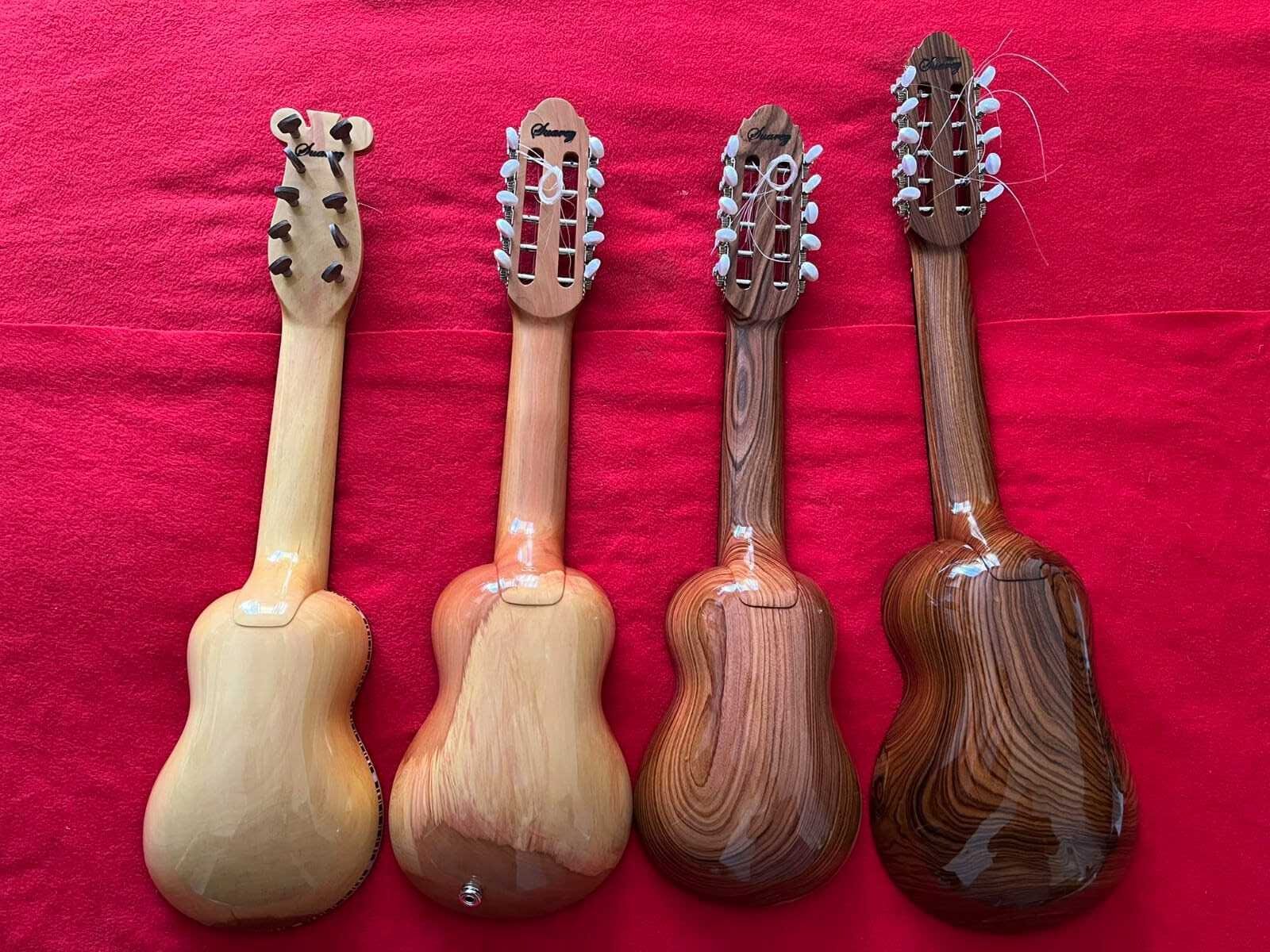
The backs of four charangos by Ignacio Suarez 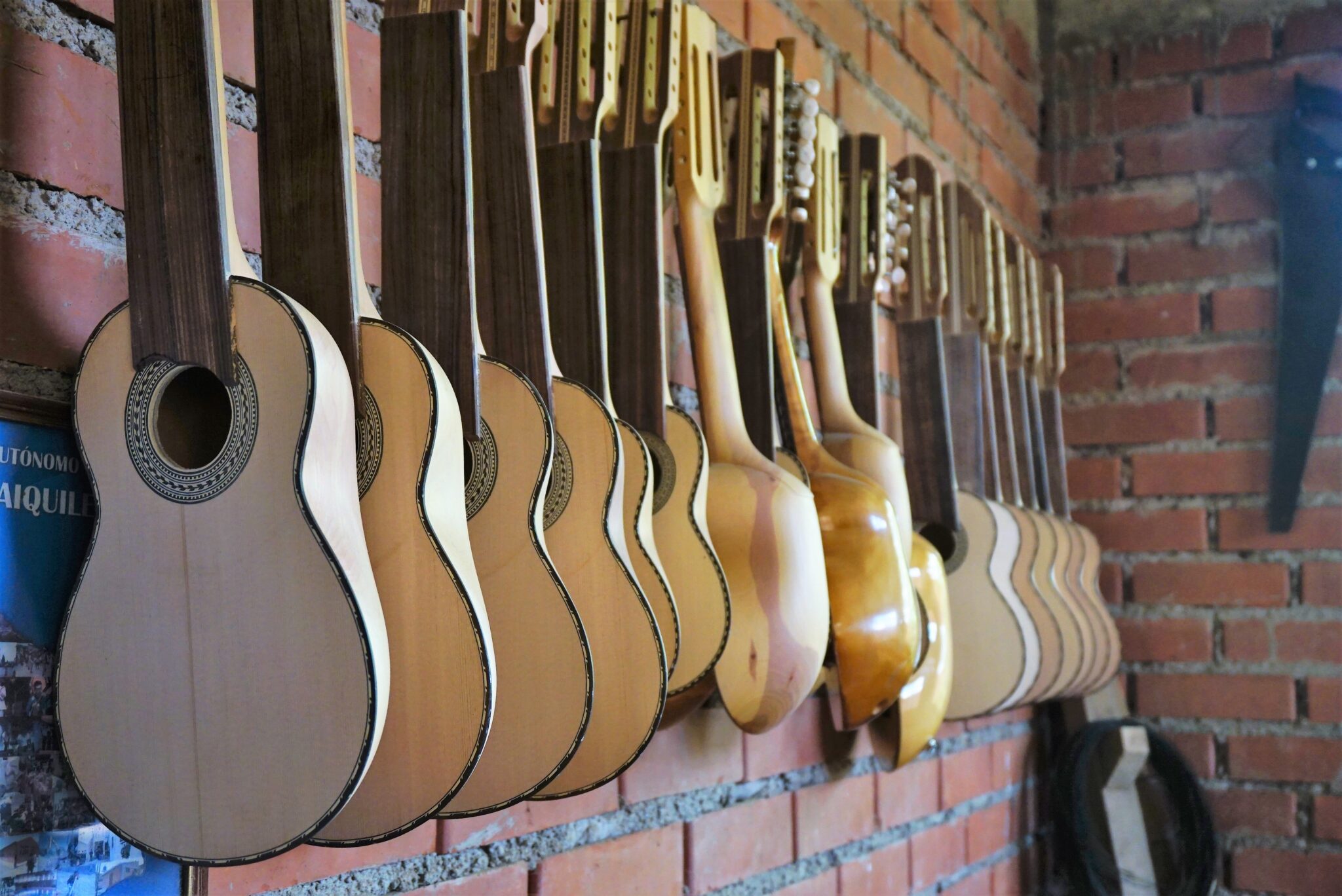
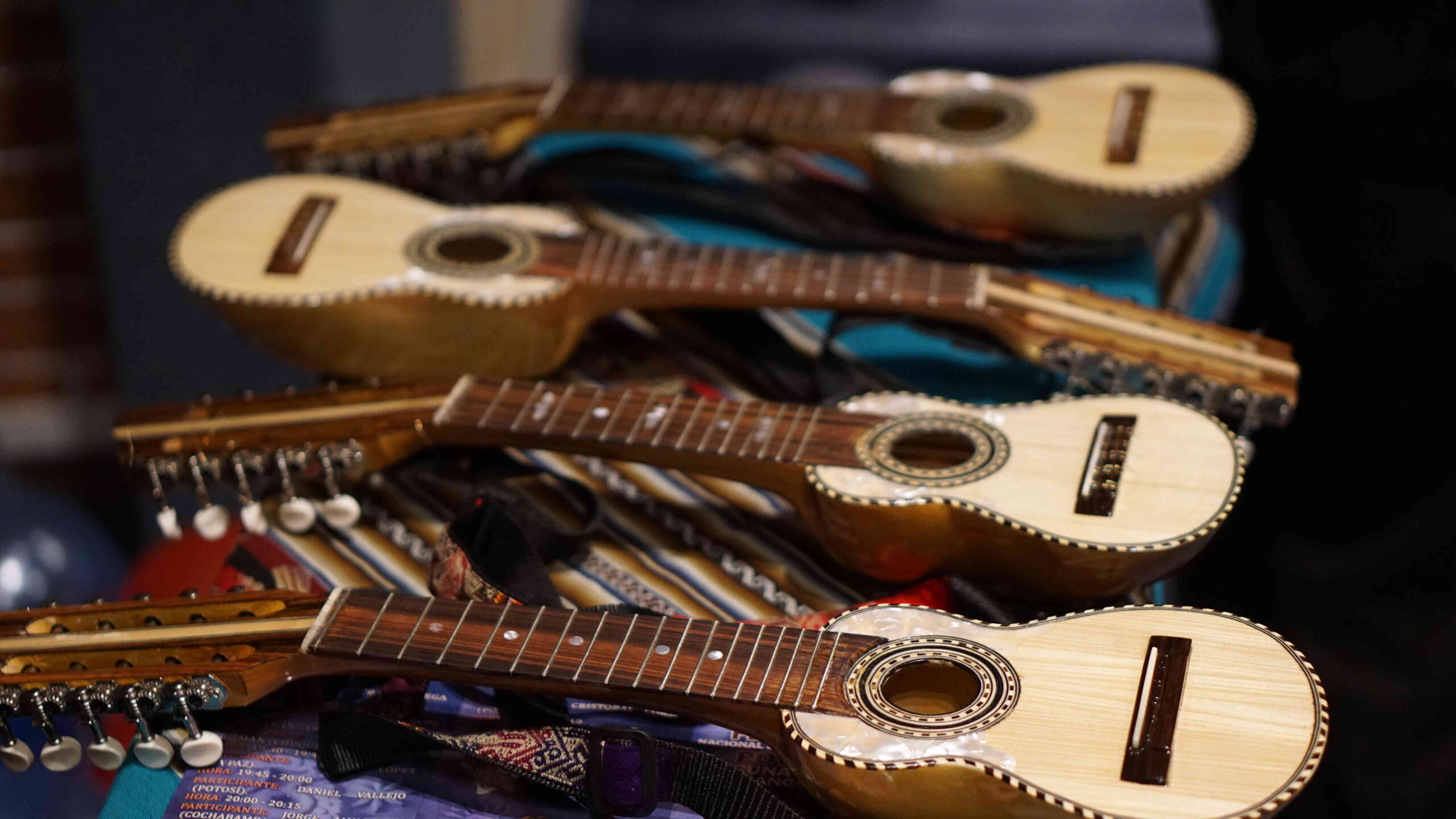
Charangos waiting to be finished
The origins of the charango
The charango has a rather ancient origin. It is the evolution of the baroque guitars and vihuelas that the Spanish brought to their South American colonies in the 16th and 17th centuries. These instruments, which the European aristocracy played for its own pleasure, soon spread beyond the palaces of the nobility, meeting the interest of the indigenous populations. Until that time, there were no chordophones on the American continent, but only percussion and wind instruments.
Over the centuries, the tastes of the Indigenous peoples reshaped the form and role of these instruments, slowly creating what we know today as the charango. To really understand what the charango is, it is essential to travel to Bolivia. There, if one goes deep into the rural communities, one realizes how many variations of these instruments still exist today: almost every community has developed its own variation and tuning, creating an immense legacy of music and rituals that revolve around the charango as an instrument of social life. There are hundreds of them, of which unfortunately many are now almost extinct.
The charango that has spread around the world today is one of many variations, which came into its own during the 1950s thanks to an outstanding Bolivian musician and artist of great importance, Mauro Nuñez Caceres. It was he who took the charango from its rural context and brought it into the urban milieu, overcoming the strong discrimination that affected the charango and generally any expressions of rural communities. Today the charango is an instrument with a dual personality: one is the modern, concert-like, absolutely urban one, which has produced a large amount of repertoire in the last century and has spread to Chile and Argentina. The other is a rural soul, deeply connected to ancestral rituals and pre-Hispanic culture, in which the charango is not so much a musical instrument as a tool of life, with a very decisive role in the communities that possess it.
Charango tuning
The standard charango has 10 strings, but these are arranged in pairs, like a mandolin’s, so it is described as a five-course instrument. There are many tunings of the charango, but the most common is the one defined by the so-called temple natural: G – C – E – A – E

This is an open A minor seventh tuning, in which the strings all sound in unison except for the middle pair, where E is doubled in the lower octave. This particular structure requires the musician to develop a particular arpeggio technique distinct from that of other more common chordophones: if, for example, in a guitar the strings are distributed from the lowest (I string) to the highest (VI string), in the charango the order sees the lowest in the middle and the others (III – I – IV – II – V) follow in alternation. If you are looking for more information on charango tuning, read this article.
Looking for a charango?
Handmade instruments by Andean luthiers, shipped worldwide.
How the charango spread around the world
The huge number of variations of the charango in its areas of origin can be disorienting for the Western musician or scholar who is accustomed to a very strict classification of the musical instruments with which he or she plays. Those who are not involved in musicology usually conceive of these variants as examples belonging to specific families where the instrument of reference is declined in forms necessary to cover the full range of timbre: think violin, viola, cello and double bass. The musicologist, on the other hand, knows that the canonization of musical instruments into specific families is a very recent outcome with respect to the evolutionary history of individual instruments and that it does not preclude the possibility of localized types of the same instrument.
This is the case with the charango, of which we observe a surprising number of variants. These are not only variants in terms of tuning (temple), but true constructive forms that are extremely different from each other. Talking about the instrument as a whole (tuning and outward form), we realize that the first and main subdivision is that which contrasts rural instruments with urban or modern ones. Given the complexity of the subject, it is better to deal elsewhere with the differences between rural and urban charango. Let us focus here on the urban one, which is the one that has crossed South American borders spreading around the world in the last 50 years.
It is impossible to understand what the charango is today without considering the journey the instrument has made to Europe, where it has arrived only in the last forty years. For Italy, this happened thanks to the presence of Inti Illimani, the Chilean group exiled in Italy during Pinochet’s bloody dictatorship in the 1970s. In Europe, other Andean groups appeared in the same years: especially in France Los Jairas (perhaps the most important Andean group ever) and later Bolivia Manta.
In more recent times, however, the charango has become known in North America through a lower-pitched variant called ronroco, made famous around the world by the Argentine composer Gustavo Santaolalla. His soundtracks for films and series such as 21 Grams, Babel, The Motorcycle Diaries and The Last of Us all share the deep, meditative sound of this instrument.
In this beautiful piece, performed by Inti Illimani themselves, you can hear the sound of the charango in all its beauty and expressiveness.
Looking for a charango?
Handmade instruments by Andean luthiers, shipped worldwide.