

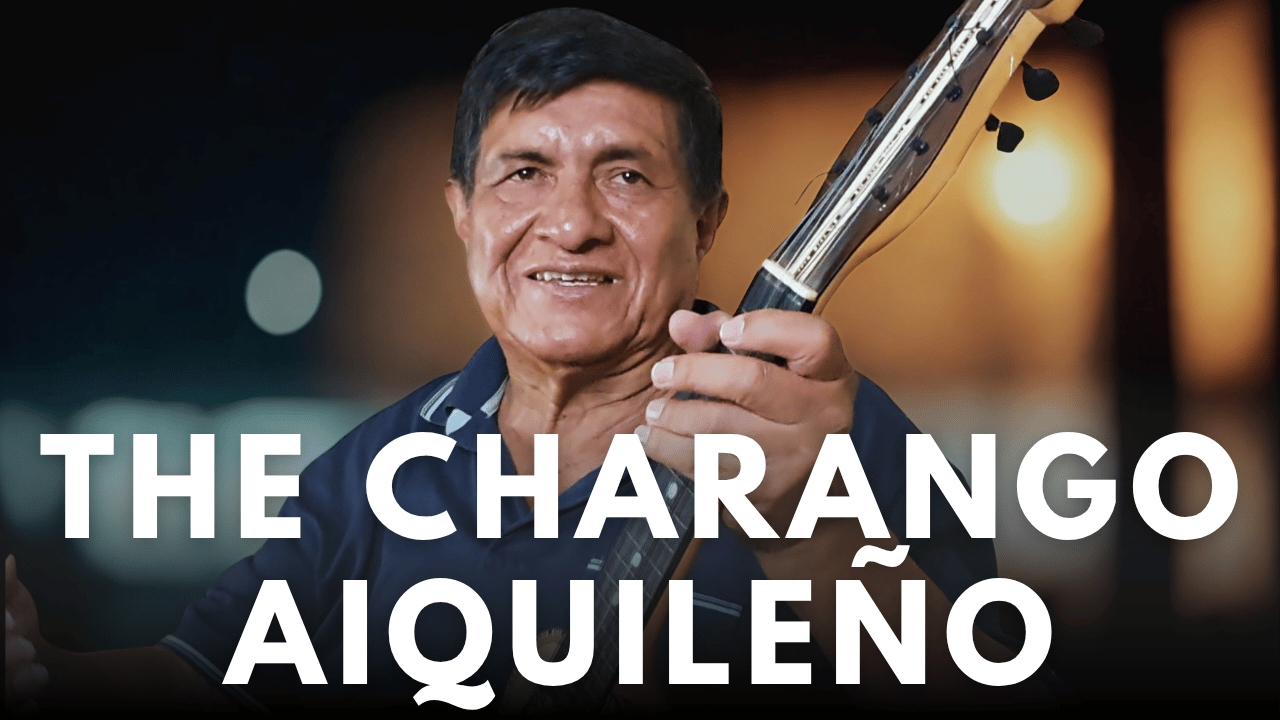
In the heart of the Bolivian valleys, at an altitude of approximately 2,500 meters, lies a small and tranquil town whose name is inextricably linked to a sound that has shaped the history of Andean music: Aiquile. Although the charango is now a celebrated instrument worldwide, few know that for over a century, Aiquile has been the world’s production capital for this instrument. It is no coincidence that its inhabitants take deep pride in this, and it has been declared by law as the “Capital of the Charango.” This is not merely a local boast: history itself bears witness to it, through generations of luthier families who have passed down the art of crafting this instrument from father to son.
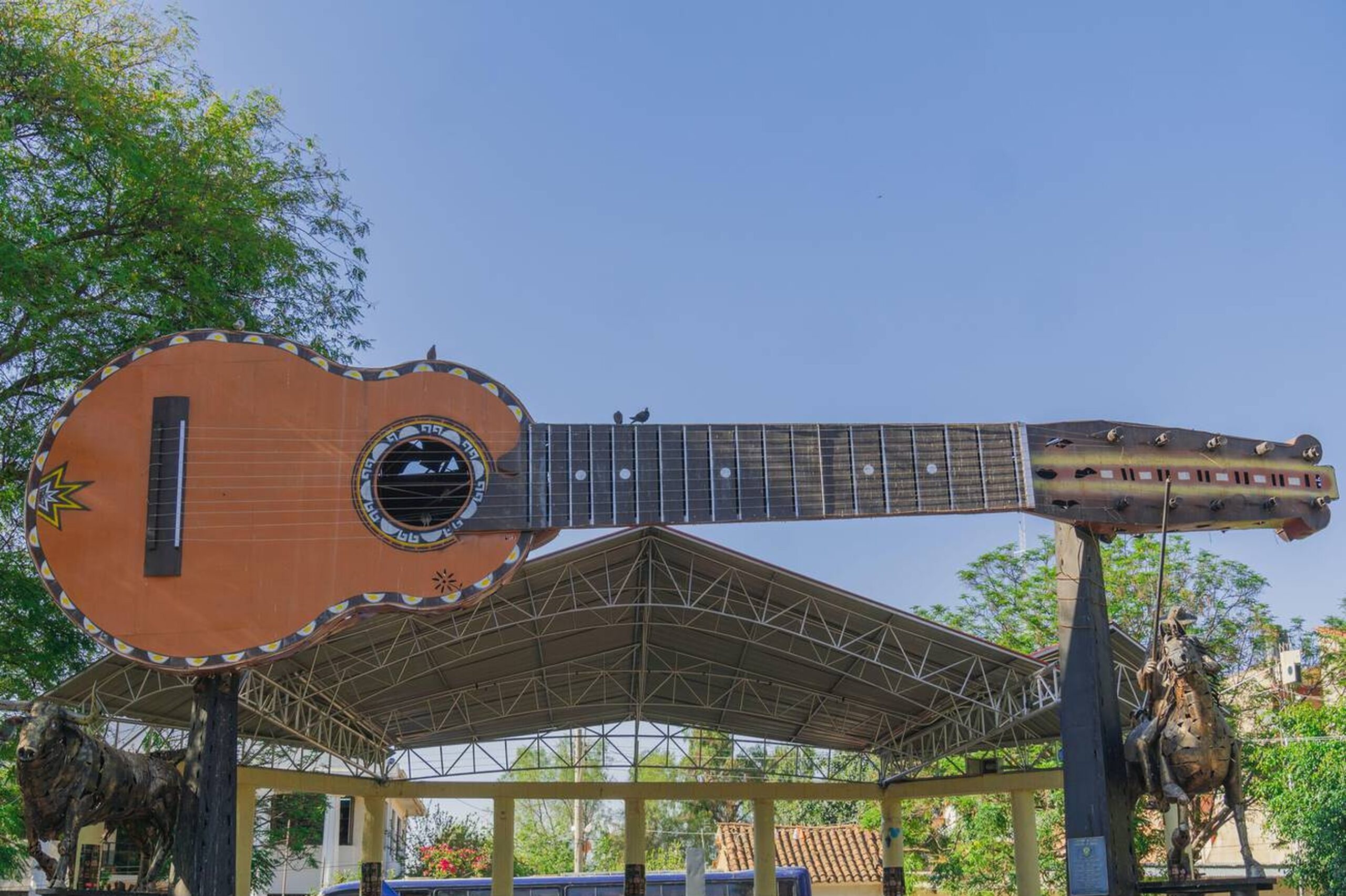
Although the workshops produced all kinds of charangos, including models typical of other regions, there was one of strictly indigenous origin: the charango aiquileño. It is an instrument with unique characteristics, although today it runs the risk of being confused with others, as the Aiquile variant is effectively one of the inspirations that serve as a reference for the modern charango.
As often happens with local variants of any cultural expression, the charango aiquileño was on the verge of disappearing. It was purely and simply a matter of market logic: changing tastes and evolving demand shifted musicians’ attention toward modern instruments, which were easier to build and adapted to the advantages of today’s materials. But let us take this one step at a time.
To begin to understand this instrument, how it came to the brink of oblivion, and how, through an act of curiosity and authentic love, it returned to production, we must first learn something about its place of origin.
Aiquile, Capital of the Charango
Aiquile, a town of approximately 8,000 inhabitants in the department of Cochabamba, boasts a tradition that has literally generated dozens of families of luthiers. According to Hernán Mérida, the current president of the Aiquile makers’ associations (2026), there are more than 120 today, but 30 or 40 years ago, there must have been many more makers. The reason for this abundance of craftsmanship is not entirely known, but it certainly has to do with the productivity of the valleys and the availability of excellent quality woods, most of which are now extinct.
In this context, a specific variant of the charango was developed. Its proportions are typical of rural charangos, as they tend to be quite compact: the neck measures between 36 and 37 cm (14 to 14.5 inches), while the width of the body rarely exceeds 18 cm (7 inches) . The result is a slender yet highly elegant instrument. The shape of the body is stylized rather than standardized, with a profile that recalls certain Baroque instruments.
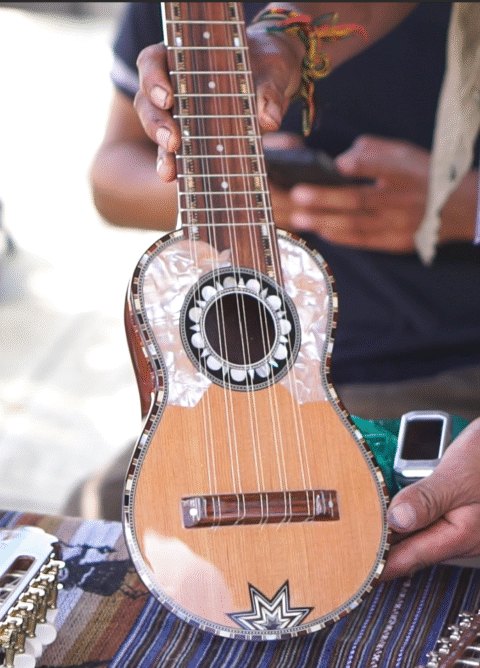
What is truly surprising about the charango aiquileño, however, is its decoration. There are two main features: the cerquillado and the front star. The cerquillado – an inlay that runs along the side of the instrument – is frequently made with three or four distinct colors. The decorative motifs are never mere ornament, but an integral part of the instrument’s identity: at the bottom of the soundboard, there appears a five-pointed half-star, also made of wood inlay. This star is a true seal of guaranteed origin: as with many other instruments, the decoration indicates not only the area of origin, but sometimes also who built it. Finally, there is the headstock, which in its most traditional form features wooden tuning pegs and has a beautiful lyre shape. The bridge, on the other hand, is strictly traditional, with front-facing tension and direct string attachment.
It is precisely this bridge that suggests we are looking at a descendant of the Baroque guitar, something that never fails to surprise anyone approaching the charango for the first time.
The paradox of success
Towards the mid-seventies, many things changed for the charango: a golden age began, marked by extraordinary worldwide popularity, as Andean folklore conquered international stages. This was the moment when Inti Illimani, Los Jairas, and other groups became hugely popular in Europe, introducing the world to the Andean repertoire and its new sounds.
This success brought with it an unexpected contradiction. The modern charango—the one built by Bolivian luthiers such as Isaac Rivas, Sabino Orozco, and Renè Gamboa, characterized by nylon strings, larger sound boxes, and a sonic aesthetic closer to the classical guitar—began to establish itself as the reference model. Then, during the nineties, under the influence of innovators like Juan Achà, the dimensions grew further, the shape of the bridge changed—borrowing from the guitar—and the sound became increasingly bright and deep at the same time, losing some of that sweetness that distinguished the charango of the sixties and seventies.
Musicians, after all, wanted to be heard in concert halls and demanded an instrument that could hold its own against chamber ensembles. It was no longer an instrument used to accompany folk songs or carnival parades. It had become a “modern” instrument, whatever that may mean. This process is still underway today in other areas of Bolivia, particularly in Norte Potosí with the Qonqhota, which adopts very bizarre decorations, characteristics, and shapes—but that is a story we will cover separately.
The price to pay in cultural terms, however, is high.
In the 80s and 90s, shortly after the end of the dictatorships, many Aiquileño master luthiers chose to emigrate, seeking better fortunes in other departments of Bolivia or even beyond the Bolivian borders, bringing their art to Cochabamba, La Paz, Chile, and Argentina, precisely to meet the new demand for instruments. This migratory movement, on one hand, ensured that the Aiquile school of craftsmanship became an unavoidable reference for charango making, as many of these masters later defined the taste and form of the modern charango. Important examples include the Orozco and Gamboa families, but also, in more recent times, the Claros and Suarez families.
These luthiers brought with them their own construction experience, rooted in the generational and vertical transmission of knowledge: the son took up the work of the father. However, they did not bring their traditional instrument, which no longer met the new market demands. Meanwhile, in Aiquile as well, the makers adapted to the demand, and the original model essentially ceased to be produced.
The chicheria and the Alfredo Coca’s intuition
The story of how an instrument whose model was no longer being built was recovered was told to me on several occasions directly by one of its protagonists, the master Alfredo Coca. Alfredo, whom I am fortunate enough to know, is one of the greatest living charanguistas; he is a musician of international stature with an extraordinarily extensive biography and collection of awards.
In the writing of this article, I asked him directly for some clarifications, and the following passage was written by Alfredo Coca himself:
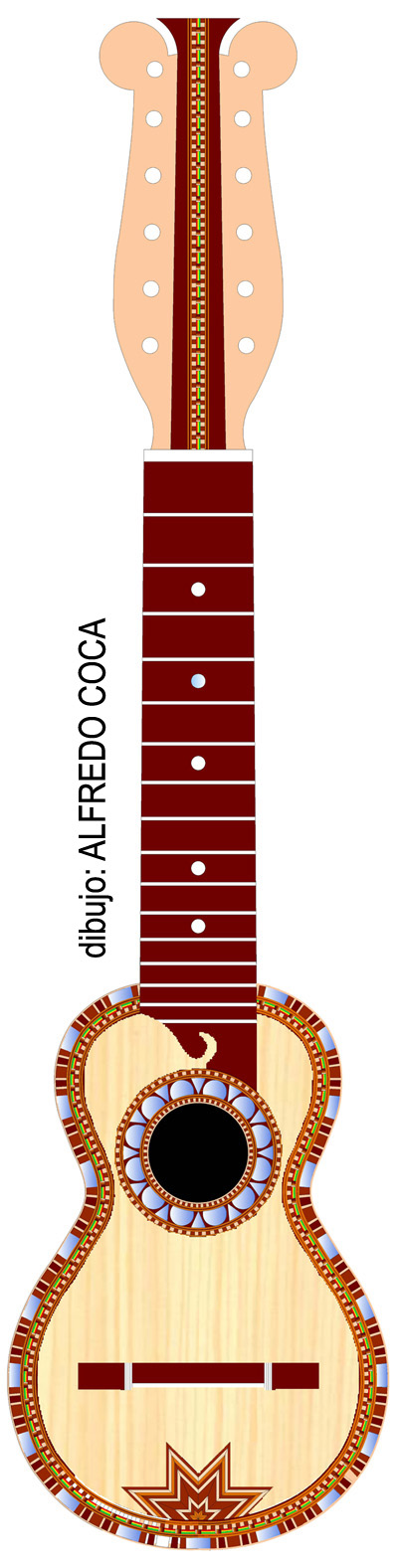
“By chance, while I was gathered with some friends, I learned that the place where we were – in Cochabamba – was an old chichería (a place where chicha, a traditional pre-Hispanic drink, is sold, Ed.) once run by an elderly lady, where gatherings featuring famous charango players of the time were organized as a social activity. I asked if, by chance, any examples from those meetings remained: the answer was yes, there was an specimen abandoned somewhere in the house. Once the instrument was found, which was broken, I immediately asked to borrow it to conduct a study. Thus began the process of digitally surveying the charango, with detailed documentation of its construction: the frets, made from hammer-forged iron wire; the bridge with direct string tension; the lyre-shaped headstock; the soundboard and sides of the instrument with combined inlays – cerquillado – made of natural-colored woods and mother-of-pearl; and a five-pointed half-star that gave the whole piece its characteristic touch. Once the survey with the exact measurements was finished, and the construction blueprint of the charango was completed, all that remained was to take it to the various workshops in Aiquile for production. Unfortunately, it was not possible to finalize the construction, as the artisans reported they did not have the time necessary for the work. As a last resort, I turned to the luthier Ignacio Suárez in Cochabamba, who called me after a month to inform me that the charango was nearing completion: my surprise was great to learn that we would have a replica of the Aiquileño specimen.”

The original model
This is the charango used as a model by Alfredo Coca, later taken to Ignacio Suárez. Note the elaborate rosette and the beautiful scroll at the end of the fretboard.
The survey made by Alfredo Coca
2008
Suárez is no ordinary luthier. Of Aiquileño origin but based in Cochabamba, he is a man who carries the Aiquileño tradition with him, and who remembered how his father used to build exactly that type of charango when he was young.
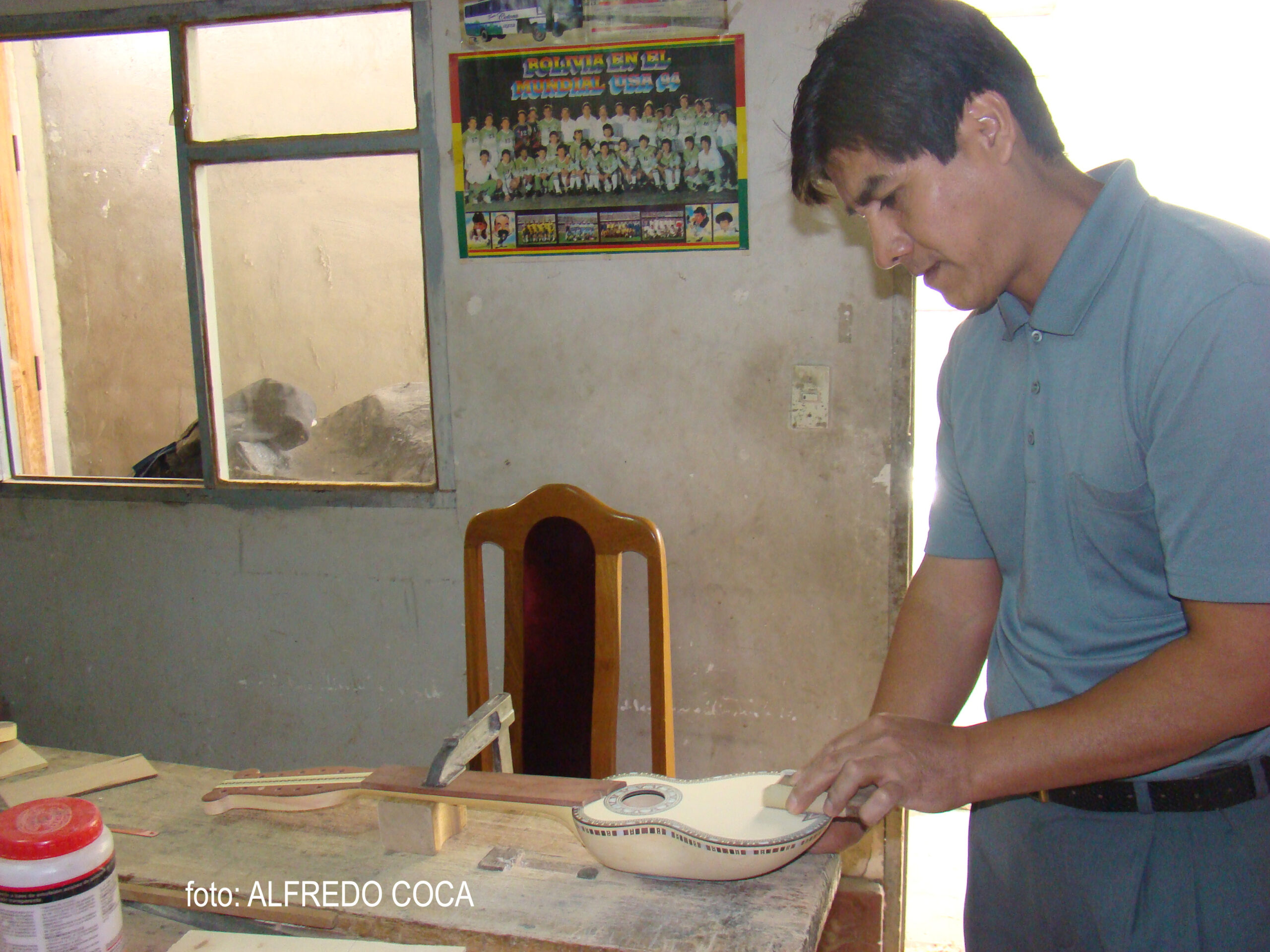
As luck would have it, the very next year, in 2009, Alfredo Coca was invited to Europe to perform at a festival organized by UNESCO, and among his instruments, he brought the new charango aiquileño. Suddenly, charanguistas from all over the world saw a new model and rediscovered a sound that no one outside of Aiquile had heard before. Within a few years, the very same luthiers in Aiquile began building it again, and currently, at the Aiquile Charango Festival, there is a special category for the charango aiquileño.
Playing a charango aiquileño is an act of love toward the cultural value of the instruments. It has an exceptional sound, very different from the sound we are already accustomed to: an authentic, ancient, and original sound, without ceasing to be – we must never forget this – an urban charango, that is to say, an instrument born in a mestizo context, not in an indigenous culture.
From Charango.it, I actively support the safeguarding of these instruments and the masters who still choose today to dedicate their lives to the tradition. I am personally convinced that the future of the charango depends on knowing its past: not as a nostalgic exercise, but as the foundation of a solid musical identity.
Would like to get one?